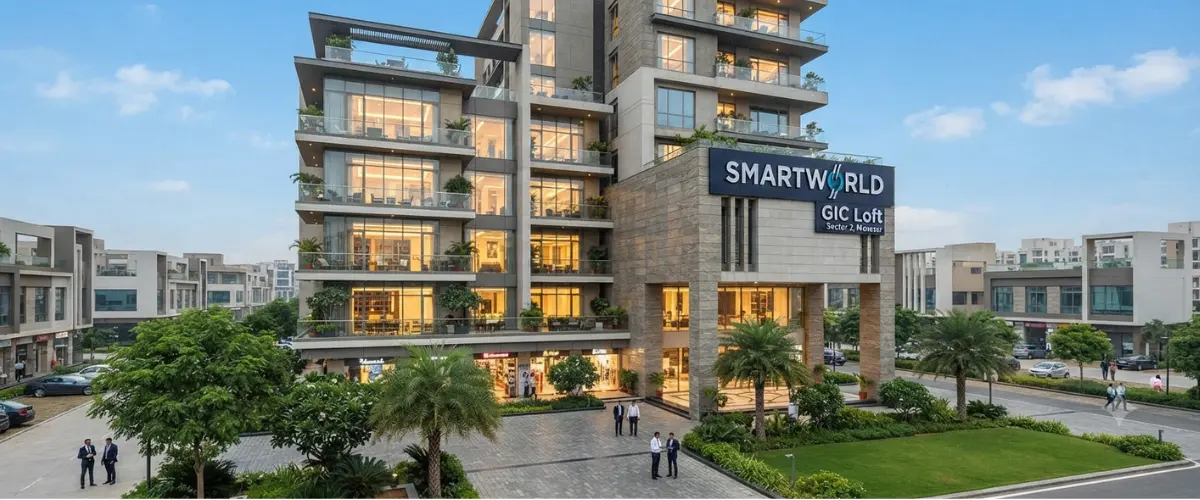
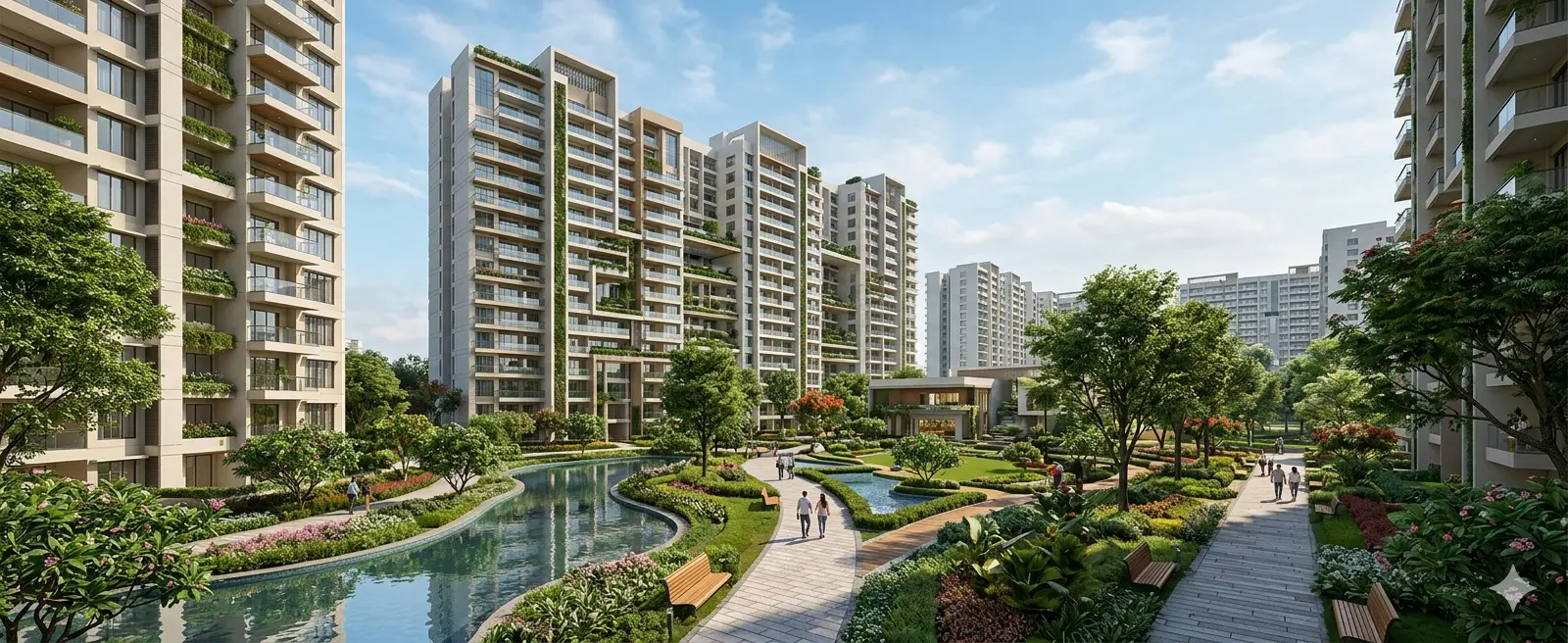
A ₹1.50 Cr loft with a promised ₹60,000/month accrual sounds like a clean 4.8% pre-launch return before you've even taken possession. Before you sign an EOI, here's what that number actually means — and what nobody's payment-plan brochure will tell you about it.
This is not a brochure rewrite. It's a working investment audit: the price math, the realistic rental yield, the hidden costs, and the honest risk profile of buying into a hospitality-managed loft format in a corridor that's still proving itself.
What Exactly Is Smartworld GIC Loft Manesar?
GIC Loft Manesar is a professionally managed, serviced-loft residential project inside Gurgaon International City (GIC) — a large, master-planned township in Sector 9, Manesar, on the Jaipur Highway. It's developed by Smartworld Developers, positioned as part of the wider M3M–Smartworld GIC ecosystem, and reportedly managed under a hospitality operating model by an established hotel-management brand.
The core product: 1-bedroom, double-height loft units of roughly 1,000 sq. ft., sold at a starting price of approximately ₹1.50 Crore, with only 12–15 units per floor for a low-density, exclusivity-led positioning.
The pitch is straightforward — you buy the unit, a hospitality operator leases and services it, and you collect rental income without managing tenants yourself. It's closer in structure to a managed hotel-condo than a conventional Gurgaon apartment.
Why this matters for how you evaluate it: you are not underwriting a standard residential purchase. You're underwriting (a) the Manesar/GIC location thesis, and (b) the operator's ability to deliver on a managed-income promise. Both need separate scrutiny.
Location Reality Check: Is GIC Manesar Actually Well-Connected?
Manesar's investment case rests on one structural fact: it sits inside a multi-decade industrial and auto-manufacturing belt (Maruti, Honda, and their ancillary supply chains) that isn't relocating anytime soon. That's a genuine, durable demand driver — corporate housing demand in this corridor doesn't evaporate in a down cycle the way speculative residential demand does.
On connectivity, the project sits near:
NH-48 — direct access to Gurgaon and Delhi
KMP Expressway — now operational, meaningfully cutting cross-regional commute times across western Haryana
A link road toward Dwarka Expressway — improving, but not yet delivering city-level connectivity
Proximity to IMT Manesar — the actual demand engine for any rental thesis here
The honest read: this is not a Golf Course Road or Dwarka Expressway-level connectivity story. It's an industrial-corridor story. If you're buying expecting Gurgaon-city appreciation velocity, recalibrate. If you're buying because IMT Manesar's corporate housing shortage is real (and it is — most rotating plant heads, MNC regional managers, and expat professionals don't buy property here, they rent premium accommodation short-to-medium term), the thesis holds up better.
Price & Payment Plan: The Actual Numbers
Item
Detail
Starting price
₹1.50 Cr for a 1,000 sq. ft. double-height loft
Payment structure
50:50 flexible plan
Booking
₹10 Lakh EOI
Within 30 days
10% of total cost
Within 60 days
40% of total cost
Balance 50%
On possession/OC
Promised construction-period accrual
₹60,000/month from booking to OC application
On paper, that accrual works out to roughly 4.8% annualized on the entry price — paid to you during construction, before the asset even generates real rental income. That's an attractive-looking number, and it's the single biggest hook in every competitor's content.
Here's the diligence layer nobody's writing: that accrual is a developer-funded pre-launch incentive, not a market-tested rental return. It tells you what the developer is willing to pay to move inventory early — it does not tell you what the unit will actually earn once real tenants, real occupancy rates, and a real operator P&L are involved. Ask specifically: is this accrual contractually guaranteed in the buyer agreement, or is it a marketing projection? That distinction matters more than the number itself.
Rental Yield: Three Realistic Scenarios
Once the project is operational, actual yield depends on occupancy, the revenue-share split with the hospitality operator, and achievable nightly/monthly rates for a 1,000 sq. ft. managed loft in Manesar — not Gurgaon city center.
Using the standard formula:
Rental yield = Annual rental income ÷ Total property cost × 100
Scenario
Assumed occupancy
Assumed monthly rent equivalent
Annual income
Gross yield on ₹1.50 Cr
Conservative
55–60%
₹65,000
₹4.7 Lakh
3.1%
Moderate
70–75%
₹80,000
₹7.0 Lakh
4.7%
Optimistic
85%+
₹95,000
₹9.7 Lakh
6.5%
These are illustrative modeling scenarios, not developer projections or guarantees — treat them as a framework to stress-test whatever numbers a sales team gives you, not as a forecast.
The moderate case roughly matches the pre-launch accrual figure — which is a reasonable sign the developer's number isn't fantasy, but it also means there's little margin of safety if occupancy underperforms in year one or two, which is common for any new managed-residence format still building a track record and tenant base.
The Hidden Costs Nobody Prices In
The ₹1.50 Cr headline is not your all-in cost. Budget for:
Stamp duty + registration — typically 6–7% in Haryana depending on category
GST — applicable on under-construction property (check current applicable rate at time of booking)
Brokerage — often 1–2% if you're going through a channel partner
Interior/loose furniture fit-out — double-height lofts often need custom furnishing to actually rent well; budget ₹8–15 Lakh if you want the unit to compete for premium corporate tenants
Maintenance/CAM charges — ask specifically what's included pre- and post-handover, and whether the hospitality operator charges a separate management fee on top of CAM
Operator revenue share — this is the number that most affects your real yield and is rarely disclosed upfront; get it in writing before booking
Realistically, your all-in entry cost is closer to ₹1.70–1.80 Cr, not ₹1.50 Cr. Run your yield math against that number, not the brochure price.
Risk Audit: What Could Go Wrong
A fair investment analysis states the downside as clearly as the upside.
Operator execution risk. The entire yield thesis depends on the hospitality management layer performing consistently. Ask for the operator's track record on other managed-residence assets in India before committing.
Thin secondary market. A 1,000 sq. ft. managed loft is a niche product. If you need to exit in 3–5 years, your buyer pool is narrower than for a standard 2/3 BHK apartment — factor this into your holding-period assumptions.
Pre-launch execution risk. Standard for any pre-launch project — construction timelines, final specifications, and even the exact revenue-share terms can shift between EOI and final buyer agreement.
Corridor maturity. Manesar is genuinely improving, but it is not yet a mature, liquid micro-market the way Golf Course Road or Sohna Road are. Appreciation here is a multi-year, infrastructure-dependent bet, not a fast flip.
Assured-return track record in India is mixed. This isn't specific to this project — it's a sector-wide caution. Get legal and financial advice on exactly how the accrual is structured before relying on it in your cash-flow planning.
None of this makes the project a bad investment by default — it makes it a specific-risk-profile investment that suits some investors (long-horizon, corridor-bullish, comfortable with a niche format) and not others (anyone needing near-term liquidity or a proven rental track record).
How It Compares
GIC Loft Manesar
Standard Smartworld/M3M GIC apartment (2.5–3 BHK)
IMT Manesar unmanaged apartment
Gurgaon-city serviced apartment
Entry price
₹1.50 Cr
₹1.75–2 Cr
₹60–80 L
₹2.5 Cr+
Management
Hospitality-managed
Self-managed
Self-managed
Hospitality-managed
Target tenant
Corporate executives, rotating professionals
Families, long-term residents
General rental market
Corporate, higher budget
Liquidity
Low–moderate (niche format)
Higher (standard format)
Higher (largest buyer pool)
Moderate
Yield potential
3–6.5% (modeled)
Lower, capital-appreciation led
Moderate, self-managed effort required
Lower, higher entry cost
The honest takeaway: GIC Loft Manesar isn't competing with standard Gurgaon apartments — it's a different asset class wearing residential clothing. Compare it against managed/serviced assets, not vanilla flats, or the comparison will mislead you.
Who Should — and Shouldn't — Buy This
A reasonable fit if you:
Want hands-off rental income and are comfortable with a managed-asset structure
Have a 5–7 year+ investment horizon and don't need quick liquidity
Believe in the Manesar–IMT industrial corridor's demand durability
Can absorb the realistic all-in cost (~₹1.75 Cr+), not just the headline price
Probably not a fit if you:
Need a straightforward, easily resellable residential asset
Want guaranteed, contractually locked returns (get everything in writing, and stress-test even that)
Are prioritizing capital appreciation over rental yield — the appreciation story here is real but slower and more infrastructure-dependent than Dwarka Expressway or SPR
FAQs
What is the rental yield of Smartworld GIC Loft Manesar?
Based on modeled occupancy scenarios, gross yield realistically ranges from 3% to 6.5% depending on post-OC occupancy and the operator's revenue-share terms — not guaranteed, and dependent on management execution.
Is the ₹60,000/month accrual guaranteed?
It's a pre-launch developer incentive during the construction period. Confirm in the buyer agreement whether it's contractually binding, and understand it's separate from the post-possession rental income model.
Is Smartworld GIC Loft Manesar RERA registered?
Verify the exact RERA registration number for this specific tower/phase directly on the Haryana RERA portal before booking — always confirm current status independently rather than relying on any third-party page, including this one.
How liquid is resale for this kind of asset?
Lower than a standard apartment. Managed/serviced lofts have a smaller buyer pool — factor a longer expected holding period into your decision.
How does this compare to buying in Dwarka Expressway or Golf Course Road instead?
Those corridors offer faster near-term appreciation and higher liquidity but at a materially higher entry price. GIC Loft Manesar trades some of that liquidity and appreciation speed for a lower entry point and a structured rental-income model.
If you've booked a unit in Smartworld Orchard, Sector 61, or you're evaluating one, you've probably already hit the same wall we did: every website quotes a different possession date. Some say "ready since December 2024." Others say March 2027. That's not a typo problem — it's a data-hygiene problem across the entire Gurgaon real estate content ecosystem, and it leaves buyers making six-figure decisions on guesswork.
SmartWorld Nature's Court is a premium residential development within the Gurgaon International City (GIC) — a 139-acre integrated township in Sectors M9, M10, and M11, Manesar, jointly promoted by M3M India Infrastructures Pvt. Ltd. and Svabhumi Realtors Pvt. Ltd. The SmartWorld brand handles design and development execution.
Smartworld Orchard is located in Sector 61 of Golf Course Extension Road (GCER)—a corridor with a growth trajectory, traffic dynamics, and resale logic that differ significantly from those of the Dwarka Expressway. Buyers often get confused between the two when shortlisting projects in this price range, leading to misconceptions regarding property appreciation, rental demand, and daily commute times. This guide clarifies the project's actual location, the true nature of its connectivity, and what it offers in terms of value for money.